

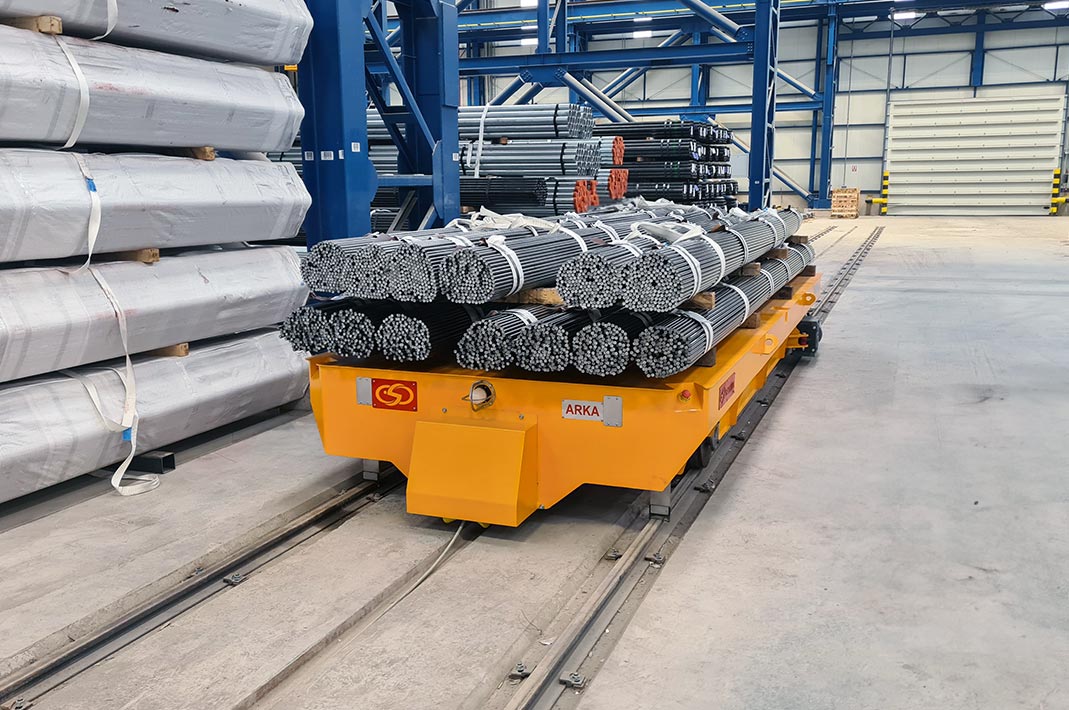
Rail transfer carts are designed for load transfer between stations along a linear track. They are engineered and manufactured according to the specific requirements of each customer, taking into account the weight and characteristics of the material to be transported. Rail transfer carts can be produced with capacities up to 1000 tons and can reach speeds of 40 m/min. All transfer carts are TÜV-approved and CE-certified. Rail-based load handling systems accelerate workflow within the facility and contribute to creating a safer working environment.
Depending on the type and shape of the load, the carts can be customized with various configurations. They are primarily preferred in heavy industries such as the automotive sector, where the reliable movement of high-weight components is critical. However, depending on operational needs, trackless (battery-powered) versions can also be produced as an alternative solution.
Rail Transfer Cart Projects
Areas of Use for Rail Transfer Carts
Rail transfer carts are used in industrial environments where heavy loads need to be transported safely and stably along fixed routes. They are particularly preferred for organizing the logistical flow between the production line, assembly area, and storage sections. The stable movement offered by the rail system enhances both workplace safety and production continuity. For this reason, they play a critical role in load handling operations across various sectors, from heavy industry to aerospace, automotive, and defense industries.
- Heavy Industry
Rail transfer carts are effectively used in steel production plants for transporting large casting parts, molds, and steel coils from one point to another. These systems ensure safe transportation even under high-temperature and dusty conditions. They are also preferred for transferring aluminum and other metals to processing lines or storage areas. The fixed rail track provides controlled and secure movement in such demanding industrial environments. - Automotive Industry
In the automotive sector, rail transfer carts ensure the safe transportation of heavy components such as chassis, engines, axles, and large body parts on assembly lines. Thanks to these systems, large components can be regularly transferred between stations without human intervention. The logistical flow between warehouses and production areas is optimized through rail systems, enhancing overall manufacturing efficiency. - Power Plants
In energy production facilities, rail systems play a crucial role in transporting large equipment such as turbines, generators, and transformers. Their vibration-free motion ensures that these heavy components are moved without damage. Especially during maintenance operations, these carts facilitate the controlled relocation of heavy machinery. - Logistics and Warehousing
In warehouses, rail transfer carts make it easier to move large and heavy loads between different areas. The transfer of palletized, cased, or bulk materials along designated tracks becomes safer and faster with these systems. They also reduce the need for manual labor during loading and unloading operations, increasing operational efficiency. - Shipyards
In shipbuilding facilities, rail transfer carts are used to move large steel plates, hull sections, propellers, and engine blocks. They allow for the precise positioning of large components in spacious assembly areas. The rail system enables balanced movement of these heavy parts, ensuring safety and stability during construction. - Aerospace Industry
In the aerospace field, rail transfer carts are used for moving large aircraft components such as fuselages, wings, and landing gears to the assembly area. They offer vibration-free and stable motion for operations requiring high precision. The same technology also provides suitable infrastructure for transporting heavy components used in space and defense manufacturing. - Defense Industry
In the defense sector, rail systems are used for transferring heavy military equipment such as tanks, armored vehicles, gun turrets, and ammunition between production lines. These vehicles ensure the safe and controlled movement of heavy components. They also allow precise positioning of assemblies and the timely delivery of parts to assembly zones, making them an ideal solution for defense manufacturing facilities.



Advantages of Rail Transfer Carts
Rail transfer carts provide safe, efficient, and sustainable material handling solutions for industrial production facilities. They are designed to ensure stable load movement and long-term operational reliability in environments that demand high safety and precision.
Easy Transport of Heavy Loads
Rail transfer carts are capable of safely carrying loads weighing several tons. The fixed rail track ensures perfect weight balance and vibration-free movement, which is essential in industries such as steel production, foundries, and automotive manufacturing. This feature enables the secure and smooth transfer of heavy and bulky components.High Safety
Operating on fixed rails eliminates the risk of tipping or deviation. This ensures the safety of operators and protects valuable equipment. In facilities where sensitive or expensive parts are handled, stable and controlled movement is a significant advantage for production reliability.Energy Efficiency
Powered by electric motors, rail transfer carts consume minimal energy compared to conventional handling systems. Battery- or busbar-fed versions are environmentally friendly alternatives to fuel-powered vehicles. As a result, operational costs are reduced, and the environmental footprint is minimized.Automation Compatibility
Equipped with PLCs, sensors, and remote-control systems, rail transfer carts can operate fully automatically. This improves speed and accuracy in production processes while reducing the need for operator involvement. Integration with production lines minimizes human error and prevents unexpected downtime.Durability and Long Service Life
Designed to withstand harsh industrial environments involving heat, dust, and vibration, these carts are built from high-strength steel and industrial-grade materials. Their robust chassis structure ensures consistent performance over long periods, providing a long-term investment advantage for manufacturers.Modularity and Flexibility
Every facility has unique transport requirements; therefore, rail transfer carts are developed with a modular structure. They can be customized in terms of capacity, dimensions, and control systems to suit specific industry needs. This modularity allows tailored solutions for diverse applications.Ease of Maintenance
Thanks to their modular design, components that wear out or malfunction can be easily replaced. This reduces maintenance time, prevents production interruptions, and lowers operating costs. The limited number of moving parts in electric systems also minimizes mechanical wear.Eco-Friendly Solution
Rail transfer carts reduce carbon emissions through electric or battery-powered operation. By eliminating fossil fuel usage, they contribute to sustainable production goals. Their low energy consumption, quiet operation, and long service life make them an environmentally conscious choice for industrial material handling.