
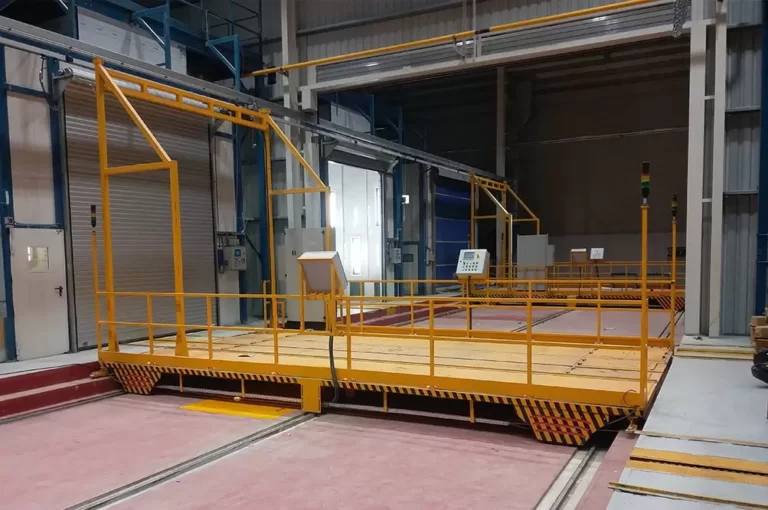
Busbar powered rail transfer carts are heavy-duty material handling systems engineered for the linear transport of high-tonnage loads in heavy industrial facilities, offering unlimited operating time. Deriving energy from an insulated conductor line (busbar) installed parallel to the rails, these systems are specifically optimized for production lines requiring high-frequency use.
By eliminating the distance limitations of cable reel systems and the charging downtime of battery-powered alternatives, this technology directly converts AC motor torque into mechanical motion, delivering maximum efficiency in assembly lines, foundries, and logistics centers.
Operating Principle and Busbar Integration
Busbar powered transfer carts obtain energy via a sliding contact line. The fundamental working principle of the system relies on the following components:
- Conductor Rail Line: These are insulated conductor bars, typically mounted in a trench opened in the ground or installed alongside the rail.
- Current Collector: A mechanical arm mounted on the transfer cart that maintains continuous contact with the conductor bar while in motion, transmitting electricity to the motor.
- AC Motor and Reducer: Converts the received 380V – 440V (or custom voltage) energy into mechanical motion, managing the start-stop and speed control of the cart.
This structure minimizes energy loss, eliminates the risk of cable dragging, and enables the system to operate 24/7 without interruption.
Advantages Compared to Cable Reel and Battery Systems
In industrial purchasing decisions, operating cost (OPEX) and operational continuity are decisive factors. Busbar systems offer the following technical advantages: Unlimited Operating Time: Unlike battery-powered vehicles, they do not require recharging; thanks to continuous power supply, there are no downtimes in shift systems.
- No Distance Limitation: While cable reel cars are limited after a certain length due to cable tension and weight, busbar systems can operate at unlimited distances as long as the rail line is extended.
- High Load Capacity: Direct mains power supply saves on battery weight and allows the motor to produce full torque capacity.
- Automation Compatibility: It is the most suitable system for PLC (Programmable Logic Controller) integration; it can be easily adapted to fully automated production lines.